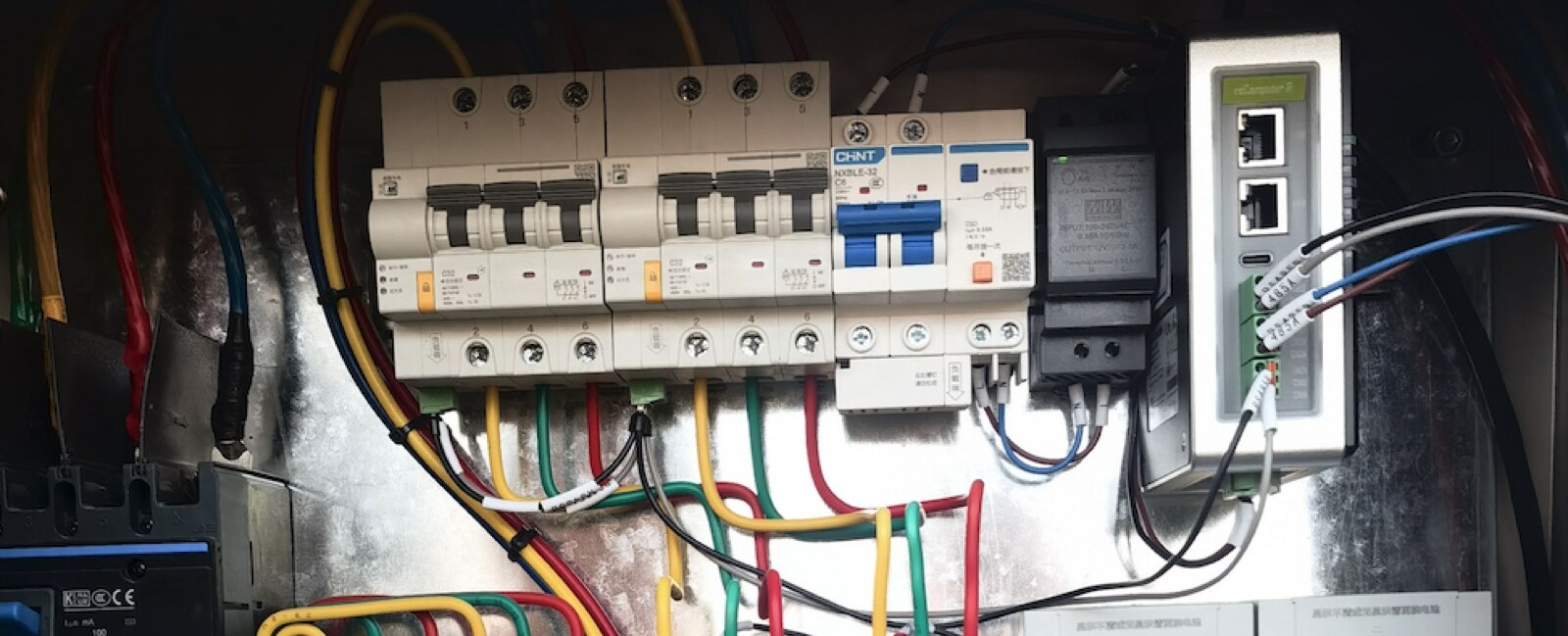
Deploying a production line digital retrofit or energy-saving project often runs into extreme fragmentation on site: heterogeneous and legacy protocols collide on the plant floor (workshops run Modbus/RS232/CANopen, buildings utilize KNX/DALI/BACnet, and utilities deploy M-Bus/LoRaWAN), while adding intelligent algorithms has traditionally required bulky, cost-prohibitive industrial computers. Engineering teams routinely encounter three major bottlenecks:
- Protocol silos and makeshift dongles: CNC machines use legacy RS232, power meters speak Modbus-RTU, motor drives require CANopen, supervisory systems demand OPC UA / BACnet, while lighting and heat meters rely on DALI, KNX, or M-Bus. Traditional engineering teams end up sourcing multiple third-party protocol converter boxes and USB serial cables inside the cabinet—creating wiring clutter, vibration disconnect risks, and ungrounded ground loops.
- Fragmented computing tiers & inflated BOM: Conventional PLCs and basic data loggers lack modern runtimes. When a project needs to add load forecasting, predictive anomaly alerts, or workstation optical inspection, teams are forced to install a separate, expensive industrial PC (IPC). Managing dual power feeds, dual enclosures, and custom inter-device communication bloats the hardware BOM and consumes limited cabinet space.
- Supply chain lead times and price volatility: Unstable chip supplies and spot-market price spikes directly impact project schedules and inflate overall deployment budgets.
The key differentiation of Seeed industrial edge controllers and gateways lies in their broad multi-protocol compatibility (core protocols direct-connected + specialized protocols expanded via standard industrial converters) and practical edge AI convenience: combining multiple fieldbuses, optocoupler electrical isolation, open Linux/Docker software stacks, and native NPU/CPU computing into compact DIN-rail devices. A single controller consolidates multi-protocol ingestion, closed-loop automation, and local AI execution.
This guide outlines an actionable selection framework across protocol coverage, edge AI capability, supply chain predictability, and electrical safety standards. All hardware interface specifications and deployment capacities derive directly from verified production hardware and committed reference designs.
💡 Related Tech Page: For fieldbus network topologies, PLC integration wizards, and system deployment documents, visit the official Field Control & Automation Solution (TECH).
Quick Reference: Core Hardware Selection Matrix
The following table synthesizes fieldbus protocol coverage, edge AI convenience, supply chain stability, and estimated procurement costs:
| Field Use Case & Project Profile | Recommended Series & SKU | Multi-Protocol I/O & Interfaces | Compute Core & AI Convenience | Key Engineering Values & Advantages | Reference Price | |
|---|---|---|---|---|---|---|
 | Primary Recommendation: Cost-effective edge control, native AI inspection & stable supply | reComputer Industrial RK3576 (RK3576-20 / 30) | Isolated RS485, Isolated CAN FD, DI/DO, Dual GbE, Mini-PCIe (LoRaWAN/4G expandable), M.2 NVMe | Rockchip RK3576 · Native 6 TOPS NPU (RKNN accelerated, YOLOv8 30+ FPS) | Consolidates data logging, PLC I/O & vision AI: Built-in NPU connects industrial cameras directly for defect sorting and OCR; onboard DO drives reject cylinders in milliseconds without a separate IPC; resilient domestic supply chain | ~$150–280 |
 | Multi-stream high-framerate industrial vision inspection on Pi ecosystem | reComputer Industrial R21 (R2135 / R2145) | Fully isolated RS485 / RS232 / CAN FD / DI / DO, Dual GbE (PoE PD supported) | Raspberry Pi CM5 (Quad-core A76 2.4GHz) · 26 TOPS Hailo-8 NPU | Flagship vision IPC replacement: Substantial compute headroom with CM5 and 26 TOPS NPU, running 2–4 high-speed 1080p cameras for defect detection; fully isolated I/O resists severe plant ground loops | ~$350–600 |
 | Plant retrofits: Legacy serial devices, CAN drives, and discrete safety contacts | reComputer R1100 (R1125-10) | 2× RS485, 2× RS232, CAN bus, 2× DI / 2× DO, Dual GbE | Raspberry Pi CM4 · CPU-based regression & adaptive forecasting | All-in-one mixed-protocol bridge: Direct connectivity for RS232, RS485, and CANopen without converter boxes; tested managing 2,000 telemetry points and local KNN setpoint forecasting; drop-in Raspberry Pi OS software compatibility | ~$240–330 |
 | Power distribution cabinets & mechanical rooms: Dense Modbus power meters | reComputer R1000 (R1025-10) | 3× independent RS485 ports, Dual GbE, USB, HDMI | Raspberry Pi CM4 · Lightweight automation flows & data normalization | Dedicated multi-trunk polling: 3 independent physical RS485 UART controllers prevent bus saturation from dozens of power meters; standard DIN-rail form factor | ~$220–400 |
 | Large facilities & campuses: Wired buses plus dispersed wireless sensors | reComputer R1200 (R1225) | Integrated LoRaWAN Gateway radio + 3× RS485, Dual GbE, Optional 4G | Raspberry Pi CM4 · Wired & wireless edge aggregation | Eliminates cable trenching: Remote points connect over wireless LoRaWAN (multi-kilometer building penetration), while electrical meters connect via RS485; replaces separate outdoor gateway + serial bridge | ~$340–470 |
 | Cabinet door integration: On-cabinet SCADA, touch interface & gateway in one | reTerminal DM | 10.1" Touchscreen (IP65 front panel), RS485, CAN, Dual GbE | Raspberry Pi CM4 · Expandable compute options | HMI display and gateway combined: Mounts directly onto cabinet doors as an interactive SCADA screen and communications gateway, saving enclosure footprint | ~$400–600 |
Note: Reference price bands reflect single-unit budgetary ranges (collected October 2026) and vary by specifications and volume; final pricing is subject to the official Bazaar store or sales quote.
To generate a comprehensive bill of materials based on project point counts and fieldbus protocols, use the interactive configurator below; for complex field setups involving mixed camera streams, specific power constraints, or custom accessory validation, you can also query our AI Solution Assistant (powered by solution-cli) directly:
🤖 Ask the AI Solution Assistant (Powered by Official Hardware & Accessory Database):
- Instant Terminal Query: Run
npx @seeed-studio/solution-cli hub get industrial-control-automation --sections products,architectureto inspect recommended hardware and topologies in one step.- Natural Language Q&A: Ask directly in Claude Code, Codex, Antigravity, or Cursor (e.g., "We have 30 Modbus power meters and 2 workstation inspection cameras needing local YOLOv8 inference and reject solenoid triggers; please recommend controller SKUs and required power accessories"). The AI assistant calculates compute loads and verifies box contents. Learn more in the solution-cli documentation and installation guide.
Configure Your Solution
Builds a single trial kit from your device interface and backhaul; confirm frequency band, power and point count with a solution expert
Field Connection Trial Kit
One data logger or gateway host, matched to your device interface and backhaul
硬件/物料名称 数量 型号/SKU 说明 reComputer Industrial RK3576-30 1 100094701 - Data server (cloud or on-site, your own) 1 - -
System Architecture: Combining Multi-Protocol Normalization with Practical Edge AI
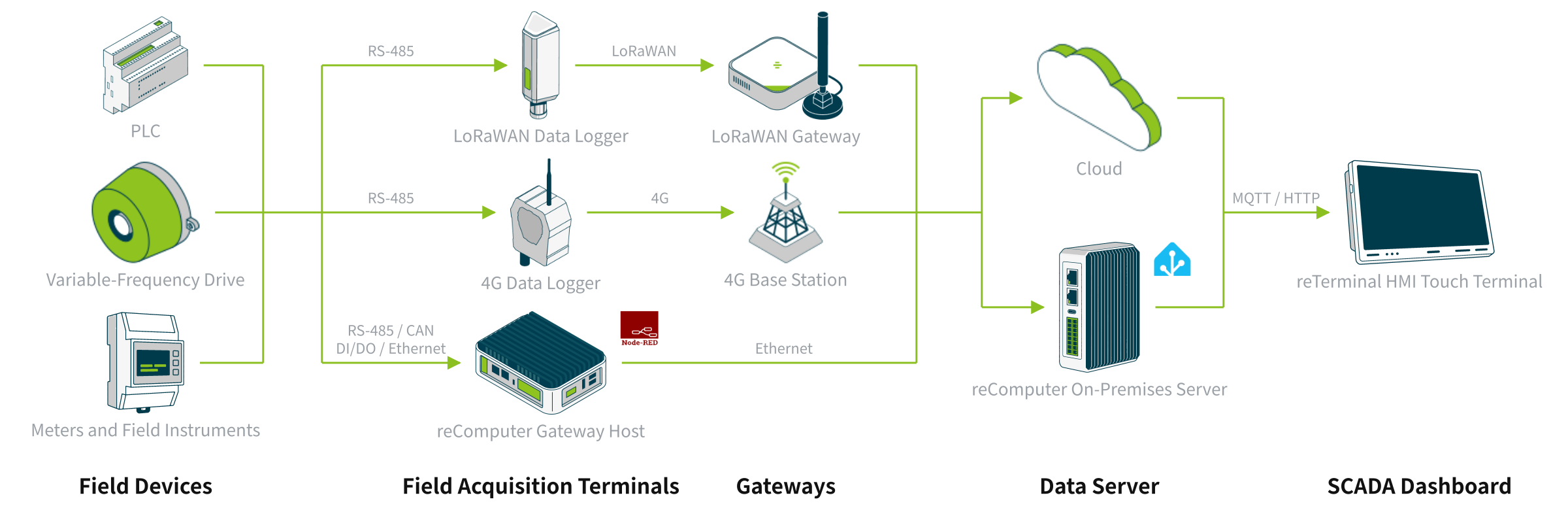
A reliable edge control architecture deployed for industrial clients enforces clear boundaries across three distinct layers:
1. Fieldbus & Multi-Protocol Ingestion: Gateway & Controller Support Matrix
When dealing with legacy serial equipment, building automation, and specialized meters on site, selection starts with two questions: what physical ports does the field require, and which gateways and controllers support them out of the box or via expansion? The matrix below maps Seeed's core industrial edge controllers and gateways against physical interfaces and typical field device protocols:
| Gateway Model | Positioning & Compute | RS-485 (Modbus) | RS-232 (Legacy CNC) | CAN Bus (Servo/BMS) | Ethernet (PLC/OPC UA) | LoRaWAN (Telemetry) | Digital I/O (DI/DO) | Vision AI Inspection |
|---|---|---|---|---|---|---|---|---|
| reComputer Industrial RK3576 | Cost-effective edge control · 6T NPU | ✅ 2× isolated | 🔌 USB dongle | ✅ 1× CAN FD | ✅ 2× GbE ports | 🔌 Mini-PCIe card | ✅ 4DI / 4DO | ✅ 6 TOPS onboard |
| reComputer Industrial R21 | Flagship Raspberry Pi CM5 · 26T Hailo-8 | ✅ 2× isolated | ✅ 1× isolated | ✅ 1× CAN | ✅ 2× GbE (PoE PD) | 🔌 Mini-PCIe card | ✅ 4DI / 4DO | ✅ 26 TOPS multi-stream |
| reComputer R1225 | Long-range wireless station · Buildings | ✅ 1× isolated | 🔌 USB dongle | ❌ None | ✅ 2× ports | ✅ Built-in radio | ✅ 1DI / 1DO | 🟡 CPU-only compute |
| reComputer R1125 | Retrofit production lines · Pi CM4 | ✅ 1× isolated | ✅ 1× isolated | ✅ 1× CAN | ✅ 2× ports | 🔌 Module expansion | ✅ 4DI / 4DO | 🟡 CPU-only compute |
| reComputer R1025 | Substation panels · Dense 485 metering | ✅ 3× isolated | ❌ None | ❌ None | ✅ 2× ports | 🔌 Module expansion | ✅ 4DI / 4DO | 🟡 CPU-only compute |
| reTerminal DM | Cabinet panel HMI · 10.1-inch touch | ✅ 1× isolated | ✅ 1× isolated | ✅ 1× CAN | ✅ 2× GbE ports | 🔌 Module expansion | ✅ 4DI / 4DO | 🟡 CPU-only compute |
Legend:
- ✅ (Direct): Onboard native isolated physical port, plug-and-play without extra converters or expansion cards;
- 🔌 (Expansion): Supported via onboard Mini-PCIe / M.2 wireless slot, USB dongle, or external bus converter;
- 🟡 (Soft compute): Relies on quad-core CPU compute for telemetry regression and statistical forecasting (no dedicated NPU accelerator);
- ❌ (Unsupported): Port not available onboard (microsecond / nanosecond hard real-time multi-axis motion control requires BeagleBoard / TI hardware OEM customization).
Common Field Protocols & Software Driver Ecosystem:
- Modbus-RTU (Power meters / Temp controllers / VFDs): Native onboard RS-485 port, parsed locally via libmodbus, Node-RED, or EdgeX Foundry (R1025 features 3 isolated channels to eliminate bus polling latency).
- Industrial PLC (Siemens S7 / Mitsubishi MC / Omron FINS): Direct communication over dual GbE ports via snap7 / libplctag without expensive proprietary communication modules.
- BACnet/IP & OPC UA & Modbus-TCP (Building DDC / SCADA / DCS): Native GbE direct connection, normalizing tag models locally with open62541 and bacpypes.
- CANopen / CAN FD (Servo drives / AGV chassis / Battery BMS): RK3576 (supporting CAN FD), R21, and R1125 connect directly via Linux SocketCAN standard drivers.
- RS-232 Proprietary (Legacy CNCs / Barcode scanners / Scales): R1125 / R21 / reTerminal DM offer native screw terminals; RK3576 / R1025 / R1225 support industrial USB serial adapters.
- LoRaWAN Wireless (Pipe temp / Environmental / Smart meters): R1225 features built-in SX1302/1303 concentrator with ChirpStack; RK3576 / R21 expand via Mini-PCIe cards.
- Specialized Building & Thermal Meters (KNX / DALI-2 / M-Bus): Connect via GbE to standard KNX-IP routers, or via onboard RS-485 to external DALI or M-Bus level converters.
Key Field Architecture Trade-offs:
- Conventional PLCs: Why Direct Ethernet Is Preferred, and When Couplers Are Mandatory:
- Direct Ethernet First: For data acquisition, operational monitoring, and non-isochronous control, Siemens S7, Mitsubishi MC, and Omron FINS run natively over standard TCP/IP. A single standard patch cable to the controller's GbE port achieves sub-100ms updates without extra hardware.
- When Couplers Are Required (PN/PN Coupler): When handling microsecond isochronous real-time servo loops (PROFINET-IRT / EtherCAT Slave requiring dedicated ASIC) or when integrating into an automotive OEM cell with strict network security boundaries, install a standard PN/PN coupler. Handshaking occurs over an isolated dual-port memory buffer, protecting PLC ladder scan cycles from external broadcast traffic.
- Hard Real-Time and Fieldbus Slave Customization (BeagleBoard ODM):
- Dedicated Hardware ODM: Off-the-shelf Linux rail gateways target soft real-time and telemetry streaming. When an equipment builder requires native nanosecond-deterministic multi-axis motion or integrated industrial bus slave controllers (EtherCAT Slave / PROFINET Device) within a single chassis, Seeed provides deep ODM custom engineering based on BeagleBoard (TI AM335x / AM67x / AM68x PRU-ICSS) platforms.
2. Edge Control & Processing Tier (Protocol Normalization & Engineering Convenience of Edge AI)
- Open Software Stack & Protocol Normalization: Running Debian Linux with native Docker support, the controller uses mature open tools (Node-RED, EdgeX Foundry, Home Assistant, libmodbus, SocketCAN) to parse Modbus, OPC UA, BACnet, CANopen, and custom serial protocols into standard JSON structures and MQTT topics.
 Figure: The official Multi-Protocol Gateway console—normalizing OPC UA, Modbus, and BACnet points into a unified MQTT topic contract with live quality metrics
- Practical Engineering Value Unlocked by Edge AI:
- Predictive setpoint control without manual tuning (CPU capability): In energy-intensive HVAC and thermal systems, conventional PID struggles with thermal inertia. Running on standard CM4 hardware (R1000/R1100), the system manages 2,000 telemetry points while executing local KNN or regression models on the CPU. By predicting cooling loads 1–2 hours in advance, it dynamically modulates water pumps and chiller valves (delivering 10%–15% verified energy savings in the official
smart_hvac_controlcase) without tedious manual PID re-tuning. - Single-box workstation vision inspection (NPU acceleration): In assembly and defect classification workstations, the Industrial RK3576 (native 6 TOPS NPU, accelerating YOLOv8 via RKNN) or Industrial R21 (26 TOPS Hailo-8) connects directly to industrial USB/Gigabit cameras. The controller carries out workpiece positioning, missing-part detection, OCR, or dial gauge reading, then immediately triggers reject solenoids via onboard DO—eliminating the need for a separate vision IPC.
- Predictive setpoint control without manual tuning (CPU capability): In energy-intensive HVAC and thermal systems, conventional PID struggles with thermal inertia. Running on standard CM4 hardware (R1000/R1100), the system manages 2,000 telemetry points while executing local KNN or regression models on the CPU. By predicting cooling loads 1–2 hours in advance, it dynamically modulates water pumps and chiller valves (delivering 10%–15% verified energy savings in the official
 Figure: RK3576 / R21 industrial controllers running local vision inspection—onboard NPU handles part alignment and dimension checks in real time, triggering DO reject gates
- Containerized algorithm delivery: ML engineers can convert ONNX models to RKNN or HailoRT runtimes and package them into Docker containers. Model updates occur independently of baseline fieldbus polling services.
- Offline Autonomy: Readback verification and control loops execute entirely within the local plant network, immune to WAN outages or cloud disconnections.
3. Presentation & Upstream IT Delivery Tier (Audit & Compliance)
- Operator HMI: The cabinet-mounted
reTerminal DMdisplays operator dashboards, alarm banners, and override controls without external laptops.
 Figure: reTerminal DM mounted in a control cabinet door—runs out-of-the-box Home Assistant, Node-RED Dashboard, or industrial SCADA for on-site monitoring and alarming
- Network Isolation: Dual independent Gigabit Ethernet controllers physically partition the plant OT network from enterprise IT / cloud up-links, satisfying standard cybersecurity audits.
Four-Step Engineering Selection Guide
Step 1: Inventory Physical Protocols and Eliminate Converter Dongles
- Exclusively Modbus-RTU Devices: Choose reComputer R1000. Its 3 separate RS485 ports let you isolate heavy polling loops (e.g. one trunk for energy meters, another for environmental sensors), avoiding bus starvation.
- Mixed Protocol Environments (Serial + CAN + Digital Contacts):
- Primary for new bids: reComputer Industrial RK3576. Featuring isolated RS485, isolated CAN FD, and DI/DO. Its built-in Mini-PCIe slot enables field technicians to add LoRaWAN gateway cards or 4G LTE modules later without chassis redesign.
- Drop-in replacement for Pi legacy code: reComputer R1100. Combines 2× RS232, 2× RS485, CAN, and DI/DO on a CM4 platform for direct software migration.
- Severe Wiring Constraints: Choose reComputer R1200 to combine wire-free LoRaWAN wireless sensor reception with core wired fieldbuses.
- Specialized Building Automation & Metering (KNX / DALI / M-Bus):
- Guidance: Choose reComputer R1100 or Industrial RK3576 with multiple serial ports and dual GbE. Adding standard KNX-IP routers, RS485-to-DALI masters, or M-Bus level converters allows containerized drivers (
knxd, Node-RED, DALI tools) to normalize telemetry into unified local AI models without dedicated, high-cost proprietary building controllers.
- Guidance: Choose reComputer R1100 or Industrial RK3576 with multiple serial ports and dual GbE. Adding standard KNX-IP routers, RS485-to-DALI masters, or M-Bus level converters allows containerized drivers (
Step 2: Match Edge AI Requirements to Optimize Bid BOM
- Telemetry aggregation, logic rules, and statistical prediction:
- Guidance: R1000 / R1100 (Raspberry Pi CM4). Managing 2,000 points and a KNN setpoint forecasting service consumes only 20%–40% CPU load, avoiding the premium of GPU hardware and minimizing overall hardware procurement costs and cabinet footprint.
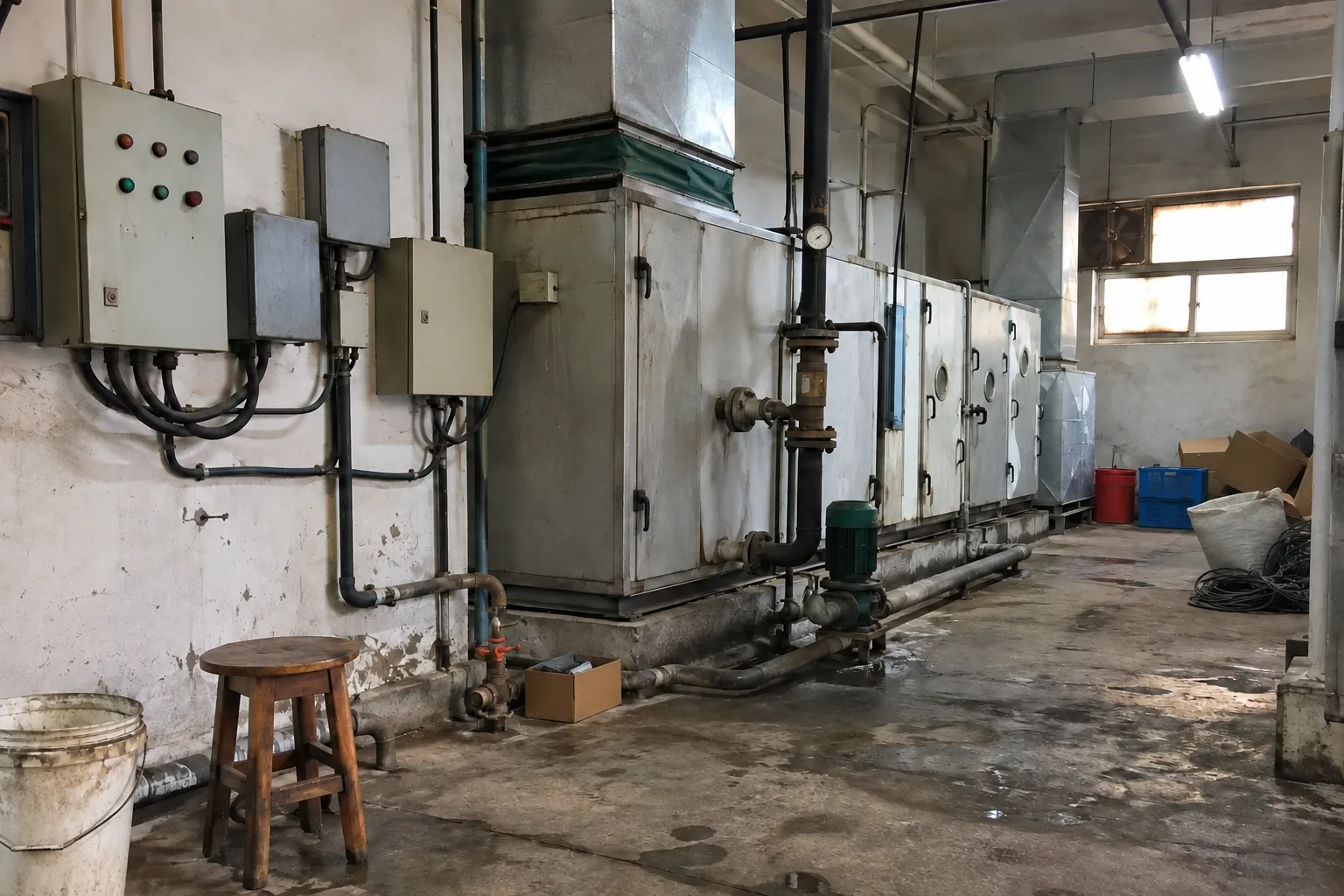 Figure: Industrial plant HVAC and pump optimization—running lightweight local regression models on a DIN-rail gateway to predict thermal loads 1 hour in advance
- Workstation defect classification, OCR, and defect detection:
- Guidance: reComputer Industrial RK3576. The native 6 TOPS NPU delivers hardware-accelerated inference in a ~$150–280 price bracket, replacing cumbersome dual-box setups ("IPC + AI companion").
- Heavy Industrial Vision: Multi-camera inspection and high-speed motion tracking:
- Guidance: reComputer Industrial R21. Combines the Cortex-A76 CM5 processor with a 26 TOPS Hailo-8 NPU for simultaneous multi-stream video pipelines.
Step 3: Assess Supply Chain Reliability and Volume Delivery
- Rockchip Ecosystem (Industrial RK3576 · Recommended for Serial Production):
- Delivery predictability: Backed by stable, long-term industrial silicon supply. Shielded from speculative spot-market pricing, making it ideal for machine builders (OEMs) and large-scale industrial rollouts.
- Raspberry Pi Ecosystem (R1000 / R1100 / R21 · Rapid Time-to-Market):
- Prototyping velocity: Best suited for teams with established Raspberry Pi software assets seeking to transition lab prototypes to factory floors with minimal porting effort.
- BeagleBoard / TI Ecosystem (Deterministic Real-Time OEM/ODM Customization):
- Customization advantage: For specialized CNC, synchronized multi-axis servo machines, or microsecond EtherCAT/PROFINET industrial appliances, Seeed delivers board-to-enclosure OEM/ODM turnkey solutions based on BeagleBoard / TI Sitara processors with hardware PRU units.
Step 4: Verify Industrial Ruggedness & Isolation Standards
Before finalizing proposals, verify three physical specifications with electrical supervisors:
- Optocoupler Isolation: The RS485, CAN FD, and DI/DO on Industrial RK3576 and Industrial R21 are optically isolated, absorbing inverter harmonics and transient ground surges.
- Operating Temperature: Unconditioned plant cabinets routinely exceed 45°C in summer. Deploy fanless equipment rated for -20°C to 60°C wide temperature operation.
- Wide DC Input & Hardware Watchdog: Ensure equipment accepts 9–36V DC industrial power and has an autonomous hardware watchdog enabled to recover instantly from power sags or software lockups.
Solution Architecture & Reference Design
- Complete Solution & Topology: Visit the Industrial Control & Automation Solution for multi-bus pinout definitions, isolation topologies, and the hardware BOM configurator.
- Multi-Protocol Industrial Edge Gateway Reference Design: Visit the Multi-Protocol Edge Gateway Implementation to verify Modbus/BACnet/OPC UA protocol translation, unified point registry, and offline buffering.
- Smart HVAC Predictive Control Reference Design: Visit the Smart HVAC Setpoint Optimization Reference Design for local KNN telemetry forecasting source code and the 2,000-point benchmark wiki.
- Edge Vision Assembly & Surface Inspection Design: Visit the Industrial Assembly & Surface Inspection Reference Design to explore YOLOv8 model deployment for missing-part and dimension defect filtering with direct DO ejection.
Data Sources & Assumptions
- Telemetry & Forecasting Capacity: Benchmark figures derived from the official Smart HVAC Control Reference Design, tested managing 2,000 registered points (including 50 verified closed-loop write points) and local KNN forecasting on CM4 (R1100).
- Hardware Specifications & Expansibility: Sourced from physical hardware documentation for
recomputer_r10,recomputer_r11,recomputer_r12,recomputer_r21_industrial,recomputer_industrial_rk3576, andreterminal_dm. RK3576 Mini-PCIe interface supports LoRaWAN radio gateway modules or 4G LTE modems. - AI TOPS Figures: Hailo-8 is rated at 26 TOPS (int8); RK3576 onboard NPU is rated at 6 TOPS (int8), per official semiconductor datasheets.
- Pricing References: Figures reflect official single-unit guide prices at publication and change based on memory options and bulk agreements.


