Vision AI for Shoppers: Footfall, Dwell and Queues
Retail stores in the U.S. and Germany count shoppers, measure dwell time and detect queues on NVIDIA Jetson Orin NX.
Three tasks: foot traffic, product recognition, unmanned-store access.
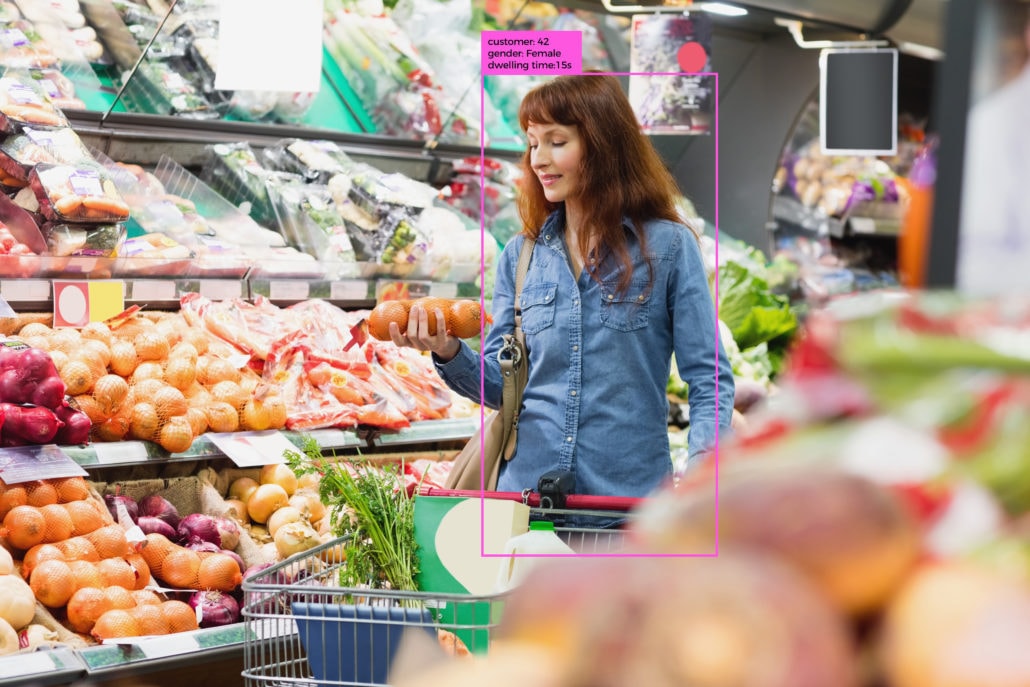
Traditional beam counters cannot separate turnarounds from dwell time; uploading raw video to the cloud incurs heavy bandwidth and GPU costs while triggering customer privacy issues.
A high-angle camera detects and tracks people on the edge device so raw video stays inside the store, returning only structured counts and floor-plan heatmaps to your dashboard.
Core Advantages
Manual barcode scanning causes slow checkout lines and high labor costs; visual shelf audits miss gaps in real time, while legacy AI requires retraining for every SKU update.
An edge host recognizes whole-basket items and audits shelf slots on site. New products register from 3–8 photos without retraining, connecting to your POS via local APIs.
Core Advantages
Physical keycards are easily lost or shared; phone QR code entry fails if the store internet drops; single-lens face readers can be spoofed by photos and videos.
An AI camera with dual-lens liveness verification matches whitelists locally and controls electronic locks, operating reliably offline while keeping tamper-proof entry logs.
Core Advantages
Determine the architecture based on new store points or existing camera reuse; edge hosts and all-in-one AI cameras close the loop on site.
Not sure which to choose? Read the Full Selection Guide →
What do you want the cameras to do? Each task maps to one reference design.
Store vision is made of cameras, a compute host, and a dashboard or console. Stores without cameras use reCamera, which captures and recognizes in one device; stores with IP cameras keep them and add a reComputer host.
Core Advantages
| Image | Product | Store Task | Optics | Measured on Device |
|---|---|---|---|---|
 | reCamera 2002 | Footfall and heatmap (small nearby area) | 1080P | — |
 | reCamera Pro | Unmanned store access; footfall (large area) | 4K | Face to unlock signal 0.66 s (1000-person library) |
This block covers store capture. Points without cameras use reCamera 2002 / Pro, one device for capture and recognition; points with IP cameras keep them and send the stream to the compute host. Position sets quality: footfall sits high looking down, 3–5 m out, Pro (4K) for large or distant areas; checkout sits directly above the belt, items fully visible; shelf cameras face the shelf, sample full shelves by slot, 3+ photos per SKU; access sits at face height where people stop, away from backlit doorways and glare, calibrate after mounting.
Core Advantages
| Image | Product | Store Task | Camera Input | Measured on Device |
|---|---|---|---|---|
 | R2135-12 | Footfall and heatmap | IP camera (RTSP) | 14.3 FPS tracking per camera (15 FPS source) |
 | RK3588 | Shelf recognition; footfall and heatmap | IP camera (RTSP) | Shelf: detection to result 924 ms (p50); footfall 13.2 FPS per camera |
 | RK3576 | Footfall and heatmap | IP camera (RTSP) | 13.3 FPS tracking per camera |
 | J4012 | Checkout recognition; footfall (several cameras per host) | IP camera (RTSP) or USB | Checkout: detection to result 22.3 ms (p50), 0 dropped in 2956 frames |
 | J3011 | Unmanned store access (existing camera) | IP camera (RTSP) | — |
This block pulls RTSP streams and runs detection and recognition. Footfall rates are single-stream; test before sizing a host for several cameras. Checkout and shelf figures come from the reference designs.
Core Advantages
Yes. Any IP camera with an RTSP stream connects to a reComputer host, and nothing on the wall changes. Footfall needs a camera mounted high, looking down; access control needs one at roughly face height. If an existing position does not fit, move the camera or add one.
Footfall video is processed in the store; the backend stores only counts, zone totals and dwell times, and the heatmap shows where people are, not who they are. Product recognition results and the product library also stay on the store's local network.
No. Register each SKU with 3–8 photos; every library version is kept and can be rolled back. On the Grocery Store Dataset (81 classes) with 8 enrolment photos per SKU, top-1 accuracy is 84.67%. Fewer photos lower accuracy, so shoot several angles.
This page covers vision only. For microphones fixed at counters and tills that record service conversations, see Store & Counter Service QA. For badges worn by staff on the move, see In-Person Conversation Intelligence.
Yes. The Seeed devices used here support custom logos, enclosures, packaging and preinstalled firmware, and interfaces or features can be added to or removed from existing models. See ODM/OEM customization for scope and process, or .