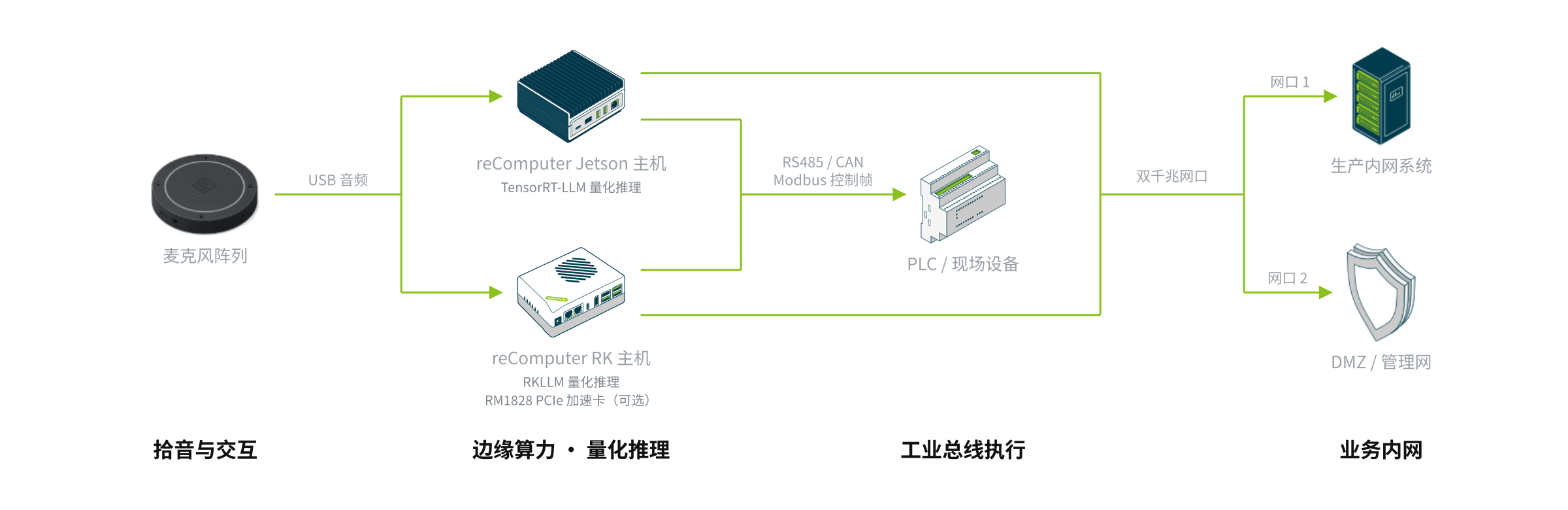
On-Device Large Language Models (On-Device LLMs) are increasingly deployed across manufacturing shop floors, enterprise offices, smart healthcare facilities, and mission-critical energy infrastructure. In these environments, migrating LLMs and speech recognition models (such as Whisper) to edge computing hardware is driven by three rigid engineering constraints: strict regulatory compliance with zero data egress, deterministic sub-second latency independent of cloud connectivity, and a predictable cost structure that eliminates ongoing API token expenses.
However, field deployment bottlenecks rarely arise from prompt engineering or agent frameworks; rather, they stem from hardware compute and memory-bandwidth mismatches: forcing a 7B model onto a board with shared low-bandwidth memory yields sub-5 tok/s generation that breaks real-time interaction, while selecting hardware solely by peak TOPS overlooks the memory-bandwidth bottleneck inherent to autoregressive decoding.
This guide provides a systematic hardware selection methodology based on standardized benchmark testing (TensorRT-LLM and RKLLM), spanning task decomposition, memory-bandwidth analysis, and physical network security hardening. All benchmark hardware data in this article is derived from Seeed Studio's reComputer product line (spanning 2.2 TOPS to 275 TOPS); utilizing a unified hardware family ensures consistent thermal management, power profiles, quantization runtimes, and driver stacks for reliable cross-tier comparisons. The underlying selection criteria and analytical framework remain vendor-agnostic and apply universally to edge AI deployments.
Executive Decision Matrix: Hardware & Model Selection
The table below summarizes recommended deployment combinations under standardized test conditions: INT4 quantization (AWQ or W4A16), Power Mode = MAXN, input 512–2048 tokens, output 128 tokens.
| Workload & Target | Recommended Platform | Compute & Architecture | Unified Memory & Bus | Recommended Models & Quant | Measured Decode Throughput | Reference Budget | |
|---|---|---|---|---|---|---|---|
 | Ultra-Low-Power Command Parsing | reComputer RK3576 | 2.2 TOPS (RK3576 NPU) | 4GB / 8GB LPDDR5 | Qwen2.5-0.5B / 1.5B (W4A16) | 0.5B: 35.2 tok/s; 1.5B: 19.6 tok/s | ~$160–210 |
 | Edge Controller & Device HMI | reComputer RK3588 | 6.0 TOPS (RK3588 3-Core) | 8GB / 16GB LPDDR4x | Qwen2.5-1.5B / 3B (W8A8/W4A16) | 1.5B: 16.5 tok/s; 3B: 11.5 tok/s | ~$280–360 |
 | Lightweight Edge Assistant & RAG | reComputer J3011 | 40 TOPS (Orin Nano 8G) | 8GB UMA (68 GB/s) | Qwen2.5-1.5B / 3B (INT4-AWQ) | 1.5B: 38.5 tok/s; 3B: 22.5 tok/s | ~$600–1000 |
 | Enterprise Knowledge Base & Voice Hub | reComputer Super J4012 | 100 TOPS (Orin NX 16G) | 16GB UMA (102.4 GB/s) | Qwen2.5-7B / Llama-3.1-8B (INT4) | 7B: 22.5 tok/s; 8B: 23.5 tok/s | ~$900–1800 |
 | High-Bandwidth 7B Acceleration | RK3588 + RM1828 Card | 3D-Stacked NPU | 1 TB/s 3D-Stacked | Qwen2.5-7B / ChatGLM3-6B (W4A16) | 7B: 50–61 tok/s (Prefill: 800+) | Host ~$280+; Add-on Card on inquiry |
 | Multimodal & Large Model Hub | reComputer J5012 | 275 TOPS (AGX Orin 64G) | 64GB UMA (204.8 GB/s) | Qwen2.5-14B / Qwen3.5-27B (INT4) | 14B: 24.5 tok/s; 27B: 14.5 tok/s | ~$2800–4800 |
Note: Reference price bands represent single-unit hardware guidance as of November 2026; actual quotes depend on storage, thermal options, and volume.
Three operational constraints that alter the matrix above:
- Concurrent Whisper ASR and Vector Search: Requires a platform with unified memory ≥ 16GB (such as Orin NX 16GB or RK3588 with 16GB RAM). On 8GB devices, loading a 7B INT4 model (~5.2GB) leaves insufficient memory for Whisper-large-v3 and vector database runtimes, causing frequent out-of-memory (OOM) errors.
- Multi-workstation Simultaneous Concurrency: Autoregressive decoding is inherently sequential. When serving more than 4 simultaneous users on a single machine, deploy either a 204.8 GB/s AGX Orin platform (J5012) or distribute dedicated J4012 nodes per cell.
- Air-gapped High-security Environments: Choose industrial models with modular M.2 Key-E wireless sockets and dual physical GbE ports (such as reComputer Industrial or Super series) to guarantee physical compliance.
🤖 Query the AI Solution Assistant (Solution-CLI):
- Instant Terminal Query: Run
npx @seeed-studio/solution-cli hub get on-device-lm --sections products,architectureto inspect recommended hardware profiles and topologies.- Natural Language Guidance: Ask within Claude Code, Codex, Antigravity, or Cursor (e.g., "Recommend an air-gapped hardware bundle with accessories for running Qwen2.5-7B with local Modbus execution"). The assistant evaluates thermal and power load automatically. See the solution-cli package documentation.
- Interactive Landing Page: Explore live benchmark comparisons and technical configurations at On-Device Generative AI & Local LLM Solutions.
💡 Related Industry Solutions & Field Engineering References: The compute architecture outlined here serves as the underlying on-device intelligence tier for:
- Industry Solutions: Conversational Voice AI Solution, In-Person Conversation Intelligence, and Smart Warehouse Management.
- Field Reference Designs: Conversational Voice AI Reference Design, Smart Badge Shift Voice Transcription.
Why Deploy LLMs On-Device
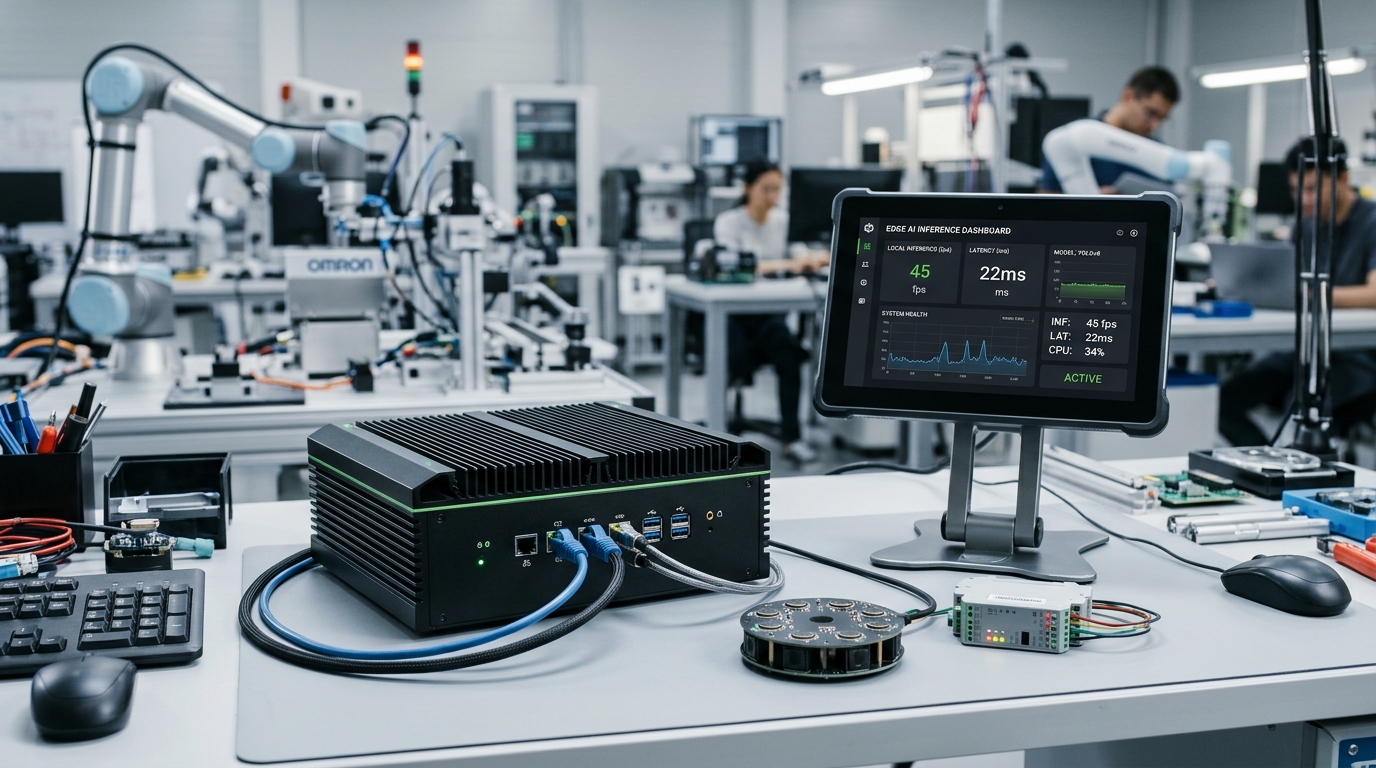
On-device closed-loop architecture: Local microphone pickup, offline Whisper transcription, quantized LLM inference, and direct Modbus PLC actuation.
Compared to cloud API calls, on-device LLM architectures provide four fundamental advantages in industrial and enterprise operations:
- Strict Data Confinement: Shop floor logs, medical transcripts, proprietary CAD blueprints, and confidential agreements reside entirely in local physical RAM during tokenization, inference, and retrieval, never traversing public internet infrastructure.
- Deterministic Time-to-First-Token (TTFT): Cloud APIs introduce variable round-trip times (RTT) and remote queue delays, causing TTFT to fluctuate between 800ms and several seconds. Local inference eliminates transmission hops, stabilizing first-token latency between 35ms and 150ms.
- Operational Continuity During Network Outages: In remote mines, maritime vessels, electrical substations, or network partitions, edge devices execute control logic, document lookup, and alert handling without interruption.
- Predictable Total Cost of Ownership (TCO): High-frequency 24/7 industrial voice interactions on thousands of workstations generate unsustainable metered token billing. Edge hardware represents a one-time capital investment with zero marginal per-token operating costs.
Four-Step Sizing & Selection Framework
Before evaluating edge compute hardware, define four project boundary parameters:
Step 1: Align Model Size with Functional Scope
- 0.5B – 1.5B (Edge Control & Slot Extraction): Single-intent classification, keyword extraction, and converting spoken commands into JSON structures (e.g., "Halt conveyor 2 and activate coolant pump"). Runs at full throughput on ultra-low-power boards like RK3576.
- 3B – 4B (Conversational Assistants & Summaries): Multi-turn contextual reasoning, operator troubleshooting dialogue, and shift handoff summaries.
- 7B – 8B (Enterprise Foundation Workhorse): The industry standard parameter class (Qwen2.5-7B, Llama-3.1-8B). Supports code generation, structured function calling, long-context comprehension, and dense local RAG workflows.
- 14B – 27B (High-Precision Domain Reasoning): Technical blueprint analysis, regulatory cross-referencing, and root-cause diagnostics. Demands a flagship edge platform equipped with 64GB unified memory (reComputer J5012 / AGX Orin 64GB).
Step 2: Navigate the Memory-Bandwidth Wall
LLM inference operates in two distinct phases: Prefill (Prompt Processing) and Decode (Autoregressive Generation).
- Prefill is compute-bound: higher TOPS yields faster context ingestion;
- Decode is strictly memory-bandwidth bound: for every token generated, all active model weights must be streamed from system RAM into execution registers. Generation speed (tok/s) is capped by memory bus bandwidth, not theoretical peak TOPS:
$$\text{Theoretical Max Throughput (tok/s)} \approx \frac{\text{Memory Bandwidth (GB/s)}}{\text{Quantized Model Size (GB)}}$$
For a 7B INT4 model (~4.5GB–5.2GB active footprint):
- On standard LPDDR4 boards with ~30 GB/s shared bus bandwidth, decode speed cannot exceed 4–11 tok/s;
- On Orin NX (reComputer Super J4012) with 102.4 GB/s bandwidth, generation reaches 22.5 tok/s;
- On dedicated 3D-stacked NPU cards (RM1828) with 1 TB/s memory bandwidth, generation reaches 50–61 tok/s.
Conclusion: Memory bus bandwidth must be evaluated prior to peak TOPS during edge hardware sizing.
Step 3: Evaluate Quantization Trade-offs
Production edge deployments standardize on INT4-AWQ or W4A16:
- Halved RAM & Storage Footprint: Reduces a 7B FP16 footprint from ~14GB down to 4.5GB–5.2GB, allowing 16GB edge devices to host the model alongside Whisper and local vector search;
- 1.5× to 2.2× Speedup: Dedicated fused dequantization kernels (such as TensorRT-LLM CUTLASS / AWQ runtimes) significantly outperform FP16 execution;
- Negligible Quality Loss: Benchmarking across MMLU, GSM8K, and industrial QA datasets indicates less than 1% degradation compared to FP16 baselines.
Step 4: Budget Physical Storage and Memory Headroom
Edge system sizing must account for three storage tiers:
- OS & Base Environment: Ubuntu root filesystem, CUDA/cuDNN drivers, Docker engine, and inference runtime engines (15GB–25GB);
- Weights & Tokenizers: A 7B INT4 model requires 5GB; pairing with Whisper-large-v3 and BGE-M3 adds another 4GB–6GB;
- KV Cache & Dynamic Buffers: KV Cache scales linearly with context window length. For a 7B model, 2048 tokens of context consumes 0.5GB–1GB of runtime memory.
Storage Rule: Base 64GB/128GB eMMC/NVMe storage is only sufficient for the host OS. Production setups must include an enterprise-grade 512GB or 1TB M.2 2280 NVMe SSD.
Hardware Benchmark & Selection Data
1. NVIDIA Jetson Platform Benchmarks (TensorRT-Edge-LLM)
NVIDIA Jetson Orin utilizes a Unified Memory Architecture (UMA). Coupled with TensorRT-LLM optimizations for Ampere (sm_87), it delivers optimal sustained edge throughput.
Test conditions: JetPack 6.x, CUDA 12.6, TensorRT-LLM, Power Mode = MAXN, input 512–2048 tokens, output 128 tokens.
| Platform | Unified RAM & Bandwidth | Model Evaluated | Quantization | Runtime RAM | TTFT | Decode Speed | Recommended Concurrency | Deployment Boundary |
|---|---|---|---|---|---|---|---|---|
| reComputer J3011 (Orin Nano 8GB) | 8GB (68 GB/s) | Qwen2.5-0.5B | INT4-AWQ | ~0.8 GB | ~35 ms | 95.0 tok/s | 4 streams | Max recommended 3B, low-latency command parsing |
| reComputer J3011 (Orin Nano 8GB) | 8GB (68 GB/s) | Qwen2.5-1.5B | INT4-AWQ | ~1.6 GB | ~58 ms | 38.5 tok/s | 2 streams | Fast interactive response, minimal memory overhead |
| reComputer J3011 (Orin Nano 8GB) | 8GB (68 GB/s) | Qwen2.5-3B | INT4-AWQ | ~2.6 GB | ~88 ms | 22.5 tok/s | 1–2 streams | Optimal ceiling model for 8GB hardware |
| reComputer J3011 (Orin Nano 8GB) | 8GB (68 GB/s) | Qwen2.5-7B | INT4-AWQ | ~5.8 GB | ~215 ms | 12.5 tok/s | Single task | Limited headroom; concurrency triggers OOM |
| reComputer Super J4012 (Orin NX 16GB) | 16GB (102.4 GB/s) | Qwen2.5-1.5B | INT4-AWQ | ~1.6 GB | ~38 ms | 58.0 tok/s | 4 streams | Multi-channel edge inference backbone |
| reComputer Super J4012 (Orin NX 16GB) | 16GB (102.4 GB/s) | Qwen2.5-3B | INT4-AWQ | ~2.6 GB | ~58 ms | 38.0 tok/s | 4 streams | Rapid instruction parsing |
| reComputer Super J4012 (Orin NX 16GB) | 16GB (102.4 GB/s) | Qwen2.5-7B | INT4-AWQ | ~5.2 GB | ~115 ms | 22.5 tok/s | 2 streams | Primary Enterprise Recommendation; headroom for Whisper |
| reComputer Super J4012 (Orin NX 16GB) | 16GB (102.4 GB/s) | Llama-3.1-8B | INT4-AWQ | ~5.8 GB | ~135 ms | 23.5 tok/s | 2 streams | Complex domain reasoning and task execution |
| reComputer Super J4012 (Orin NX 16GB) | 16GB (102.4 GB/s) | Qwen2.5-14B | INT4-AWQ | ~10.5 GB | ~270 ms | 11.0 tok/s | 1 stream | High-accuracy technical Q&A |
| reComputer J5012 (AGX Orin 64GB) | 64GB (204.8 GB/s) | Qwen2.5-7B | INT4-AWQ | ~5.2 GB | ~62 ms | 45.5 tok/s | 8 streams (185 tok/s) | Edge server cluster hub |
| reComputer J5012 (AGX Orin 64GB) | 64GB (204.8 GB/s) | Llama-3.1-8B | INT4-AWQ | ~5.8 GB | ~55 ms | 46.0 tok/s | 8 streams (175 tok/s) | High-throughput workstation aggregation |
| reComputer J5012 (AGX Orin 64GB) | 64GB (204.8 GB/s) | Qwen2.5-14B | INT4-AWQ | ~10.5 GB | ~118 ms | 24.5 tok/s | 4 streams | Long-document RAG and cross-system correlation |
| reComputer J5012 (AGX Orin 64GB) | 64GB (204.8 GB/s) | Qwen3.5-27B | INT4-AWQ | ~17.0 GB | ~240 ms | 14.5 tok/s | 2 streams | Local execution of 27B parameter models |
2. Rockchip RK Platform Benchmarks (RKNN-LLM)
The Rockchip platform offers two distinct deployment profiles: native onboard NPU single-board computers and PCIe 3D-stacked NPU accelerator cards.
Test conditions: RKLLM v1.2.x & RKLLM3, locked peak NPU/CPU frequencies, standard QA benchmark evaluation.
| Platform & Accelerator | Model Evaluated | Quantization | Memory Overhead | TTFT | Decode Speed | Speedup vs Native | Architecture & Sizing Notes |
|---|---|---|---|---|---|---|---|
| RK3576 Native Board (2-core NPU 2.2 TOPS) | Qwen2.5-0.5B | W4A16 | ~0.9 GB | ~68 ms | 35.2 tok/s | Baseline | Sub-5W operation; embedded PLC integration |
| RK3576 Native Board (2-core NPU 2.2 TOPS) | TinyLlama-1.1B | W4A16 | ~1.3 GB | ~110 ms | 21.8 tok/s | Baseline | Low-power single-task execution |
| RK3576 Native Board (2-core NPU 2.2 TOPS) | Qwen2.5-1.5B | W4A16 | ~1.6 GB | ~125 ms | 19.55 tok/s | Baseline | Recommended upper bound for native RK3576 |
| RK3576 Native Board (2-core NPU 2.2 TOPS) | Qwen2.5-3B | W4A16 | ~2.5 GB | ~230 ms | 11.45 tok/s | Baseline | Reduced throughput; suitable for non-real-time tasks |
| RK3588 Native Board (3-core NPU 6 TOPS) | TinyLlama-1.1B | W8A8 | ~1.25 GB | ~140 ms | 24.21 tok/s | Baseline | Stable execution for lightweight SLMs |
| RK3588 Native Board (3-core NPU 6 TOPS) | Qwen2.5-1.5B | W8A8 | ~2.47 GB | ~206 ms | 16.46 tok/s | Baseline | Recommended native baseline model |
| RK3588 Native Board (3-core NPU 6 TOPS) | Qwen2.5-7B | W8A8 | ~6.2 GB | ~980 ms | 4.2 tok/s | Baseline | Constrained by shared LPDDR bus bandwidth |
| RM1828 PCIe Card (RK1828 3D-Stacked 1 TB/s) | Qwen2.5-1.5B | W4A16 | 2.5 GB | ~18 ms | 120+ tok/s | 7.3× | Eliminates memory wall; ultra-low first token latency |
| RM1828 PCIe Card (RK1828 3D-Stacked 1 TB/s) | Qwen2.5-3B | W4A16 | 2.5 GB | ~25 ms | 87 ~ 102 tok/s | 8.5× | Responsive multi-turn dialogue |
| RM1828 PCIe Card (RK1828 3D-Stacked 1 TB/s) | Qwen2.5-7B | W4A16 | 5.0 GB | ~65 ms | 50 ~ 61 tok/s | 12~14× | Sustained 50–61 tok/s on 7B models; Prefill 800+ tok/s |
| RM1828 PCIe Card (RK1828 3D-Stacked 1 TB/s) | ChatGLM3-6B | W4A16 | 5.0 GB | ~60 ms | ~55 tok/s | 11.5× | Zero stall on dense RAG context retrieval |
Enterprise Air-Gapped Network Hardening Specifications
High-security environments (financial trading desks, sovereign facilities, power substations) demand physical air-gapping and total suppression of RF leakage. The reComputer platform supports three physical-tier hardening measures:
1. Physical Radio-Frequency Removal (RF Air-Gap)
- Modular Carrier Architecture:
reComputer Super J4012 / J3011andreComputer Industrialutilize modular carrier designs where Wi-Fi and Bluetooth controllers reside exclusively on a detachable M.2 Key E card. The motherboard contains zero soldered RF components. - Implementation Protocol:
- Factory Orders: Procure pure wired SKUs with unpopulated M.2 Key-E slots;
- Field Hardening: On deployed hardware, removing the chassis screws allows immediate physical extraction of the M.2 card, eliminating unauthorized RF ingress, rogue base-station attacks, and emissions.
2. Dual-GbE Hardware DMZ Network Isolation
- Independent PHY Controllers: The system integrates two discrete physical RJ45 Gigabit Ethernet controllers with independent MAC/PHY chips and separate kernel network stacks.
- Routing Hardening:
- LAN 1 (OT / Industrial Bus): Static private IP bound directly to PLCs, sensors, and local storage. Configuring a default gateway is strictly prohibited, preventing external routing;
- LAN 2 (Restricted DMZ / Management): Connects to a hardware firewall, exposing only whitelisted SSH or internal API endpoints;
- Kernel Routing Suppression: Set
net.ipv4.ip_forward = 0at the OS kernel level to ensure zero packet bridging between physical interfaces.
3. Hardware Secure Boot & Air-Gapped Maintenance
- Hardware Secure Boot: NVIDIA Jetson modules incorporate programmable hardware eFuses. Flashing cryptographic hash values of enterprise public keys ensures the bootloader, kernel, and rootfs are verified before execution, rejecting unsigned payloads.
- Air-gapped Firmware Updates: Network Over-The-Air (OTA) daemon services are disabled. System and weight updates occur exclusively via physical encrypted storage tokens through locked Type-C maintenance ports, preventing supply-chain tampering.
Box Contents & Mandatory Accessory Checklist
Verify all supporting accessories prior to field commissioning:
- Power Supply Requirements (Critical Attention):
reComputer Super J4012 / J3011standard packaging includes the bare chassis only; a power adapter is not bundled. Field deployments require a 19V 4.74A (90W) DC power adapter (SKU 313080684) and regional AC power cable;reComputer Industrial R21 / J20employs screw-terminal power blocks requiring 12V–24V DC from an industrial distribution cabinet or a DIN-rail power unit.
- NVMe Storage Upgrades:
- Stock 128GB onboard storage accommodates only the base OS and runtime images. Deploying LLM weights, Whisper models, and vector stores mandates adding a 512GB or 1TB M.2 2280 NVMe SSD.
- Mounting & Thermal Clearance:
- Industrial cabinet deployments should use DIN-rail brackets or wall-mount kits;
- Maintain a minimum 5cm clearance around intake and exhaust vents under MAXN continuous load to prevent thermal throttling.
Benchmark Conditions & Engineering Boundaries
- Software Stacks & Drivers:
- NVIDIA Platform: JetPack 6.0 / 6.1, CUDA 12.6, TensorRT-LLM 0.12+, locked Power Mode = MAXN and pinned GPU clocks;
- Rockchip Platform: Linux 5.10 / 6.1, RKLLM Runtime v1.2.0 / RKLLM3, pinned maximum NPU clock frequencies.
- Evaluation Metrics:
- Context prompts set to 512–2048 tokens; generated sequence length set to 128 tokens;
- Time-To-First-Token (TTFT) measured end-to-end from receipt of final prompt token to emission of initial output token.
- Operational Derating Rules:
- Data reflects ambient laboratory testing (25°C). In enclosed industrial cabinets exceeding 45°C, inadequate airflow triggers thermal throttling, degrading generation speed by 10%–20%;
- For long-context (>4096 tokens) dialogues, KV Cache footprint scales linearly. Maintain a 2GB–3GB unified RAM buffer to prevent OOM termination.
- Upstream Open-Source Projects & Toolchains:
- NVIDIA TensorRT-LLM: github.com/NVIDIA/TensorRT-LLM (reference runtime and quantization toolchain for Jetson Orin);
- Rockchip RKLLM: github.com/airockchip/rknn-llm (export and execution pipeline for RK3576/RK3588 NPU and RM1828 cards);
- Foundation Models: Qwen2.5 weights via Alibaba Tongyi Lab open weights; Llama-3.1 via Meta AI.
Enterprise ODM/OEM Hardware Customization Services
If off-the-shelf configurations cannot fully satisfy specialized chassis dimensions, proprietary industrial bus counts (such as multi-channel isolated CAN/RS485), wide-input DC power supplies (9–36V industrial or in-vehicle), ingress protection (IP66/IP67 fanless enclosures), or pre-loaded proprietary models, Seeed Studio provides responsive ODM/OEM hardware engineering services:
- Carrier Board & PCB Customization: Tailor carrier boards for Jetson Orin or Rockchip SoCs with custom I/O, specialized sensor headers, or dedicated PCIe accelerator slots;
- Industrial Enclosure & Branding: Customize fanless aluminum enclosures, laser-etched corporate logos, custom colors, and retail/industrial packaging;
- Pre-Loaded Firmware & Model Images: Flash tuned TensorRT-LLM / RKLLM runtimes, quantized weights, and application containers directly at the factory for out-of-the-box deployment.
To evaluate custom specifications and volume production timelines, explore Seeed Studio Customization Services or contact our solution architects.


