 Scenario
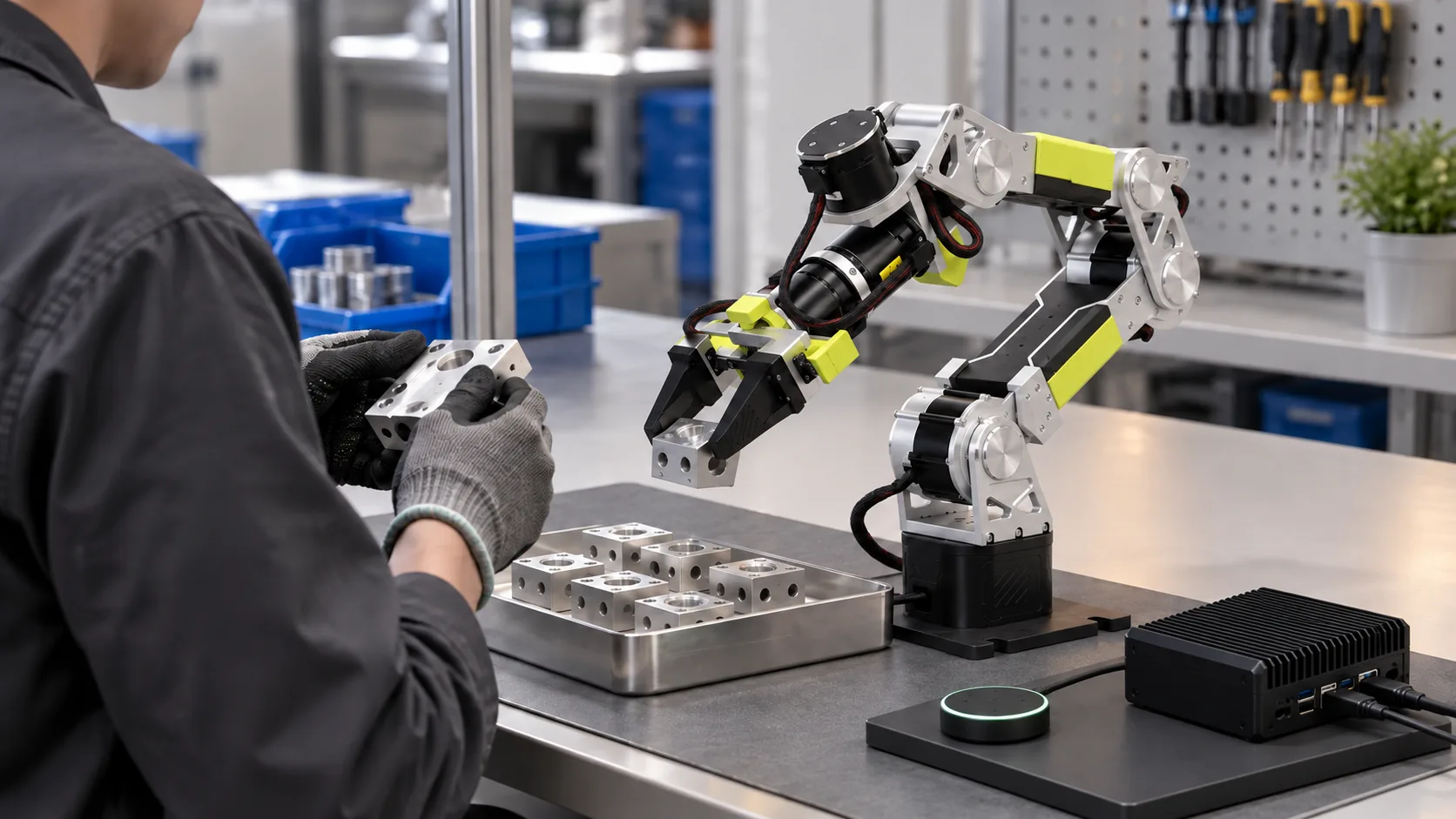
On-Site Voice Control
A voice entry point users can interrupt, added to existing equipment; recognition runs on a local host and works offline after setup.
 Scenario
A voice entry point users can interrupt, added to existing equipment; recognition runs on a local host and works offline after setup.
 Scenario
Transcription runs in the cloud or on your own host; for fixed counters and windows, see "In-Store & Counter Service QA".
 Scenario
The Watcher understands spoken commands and identifies the operator, writing results to the built-in warehouse system or your existing ERP / WMS. Deploy in the cloud, on a local host or fully offline.
 Reference design
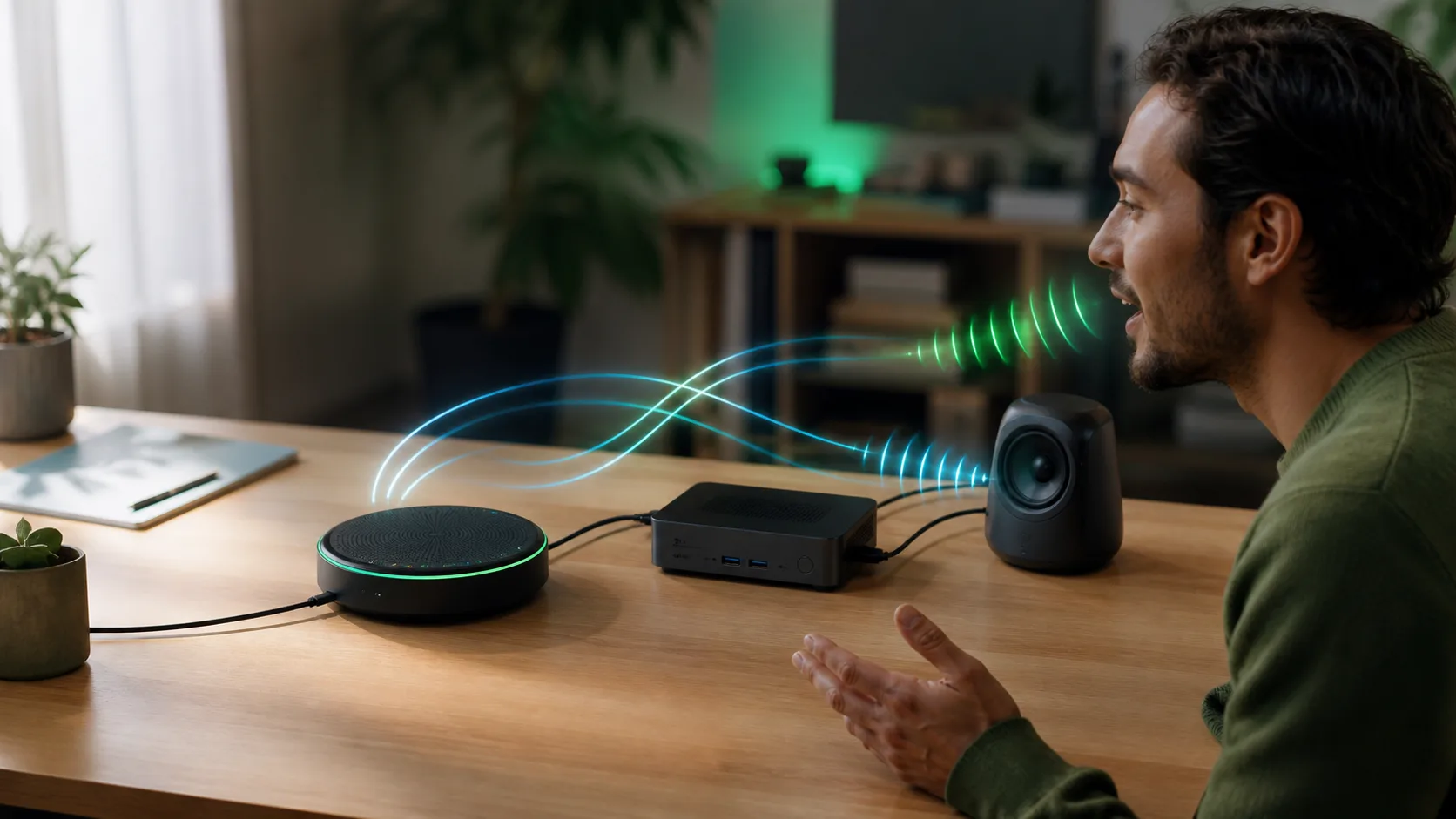
A voice terminal that answers on the device and can be interrupted mid-answer. Listening and speaking stay local; the conversation model is either your own cloud endpoint or on-device. Runs on a reComputer RK, a reComputer J30 / J40 (Orin) or a reComputer R2000 series, with the conversation language fixed at deploy time.
 Reference design
Turn SenseCAP Watcher into your voice and vision AI agent — voice dialog, proactive wake-up, and on-device face recognition
 Reference design
Sync reSpeaker Clip recordings to your own reComputer (Jetson Orin NX or RK3576) and get speaker-labelled transcripts without uploading anything to the cloud.
 Reference design
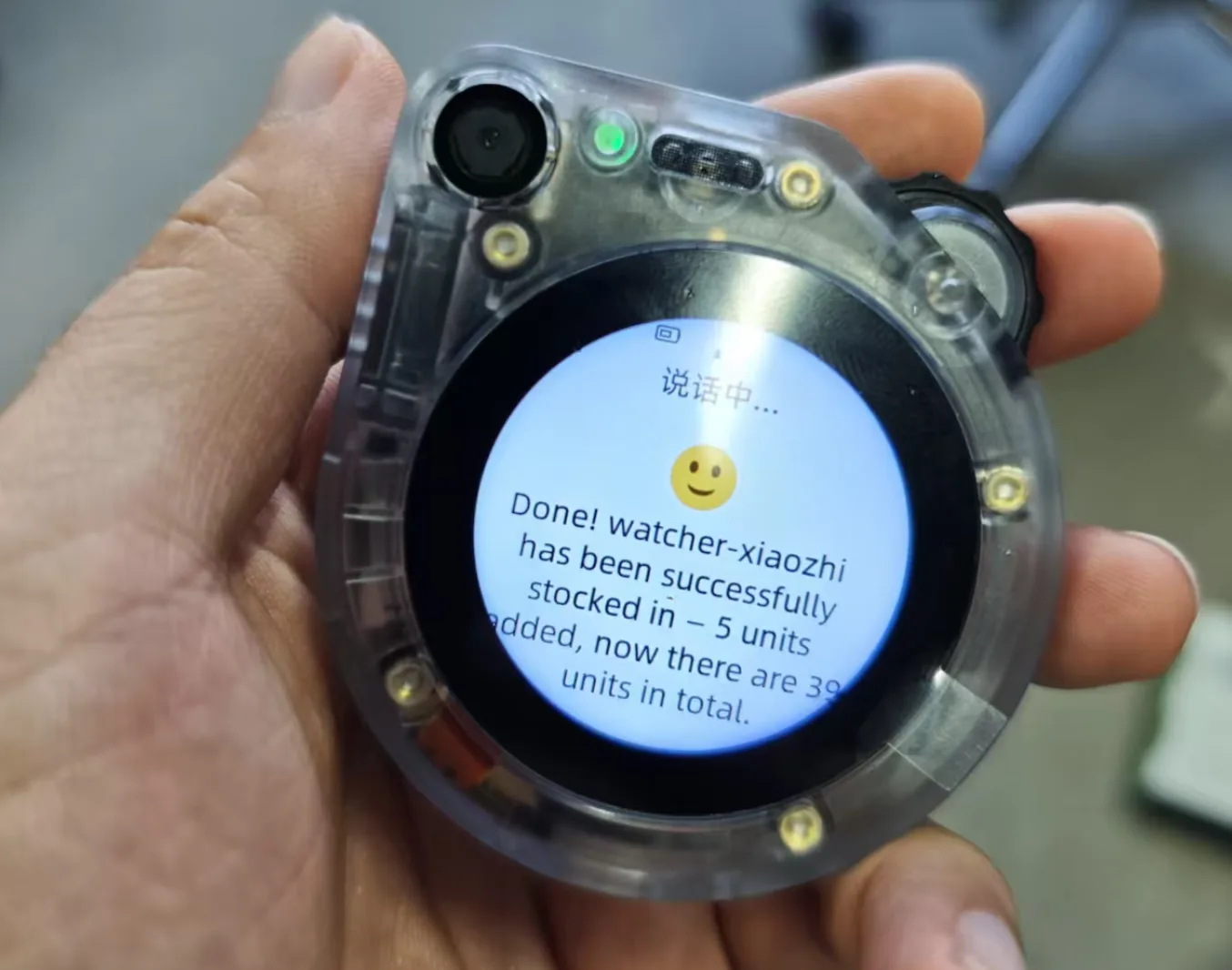
Voice-controlled warehouse management on edge hardware — speak the transaction, MCP writes it to inventory. Five tiers, from cloud trial to a fully offline Jetson deployment.
 Reference design
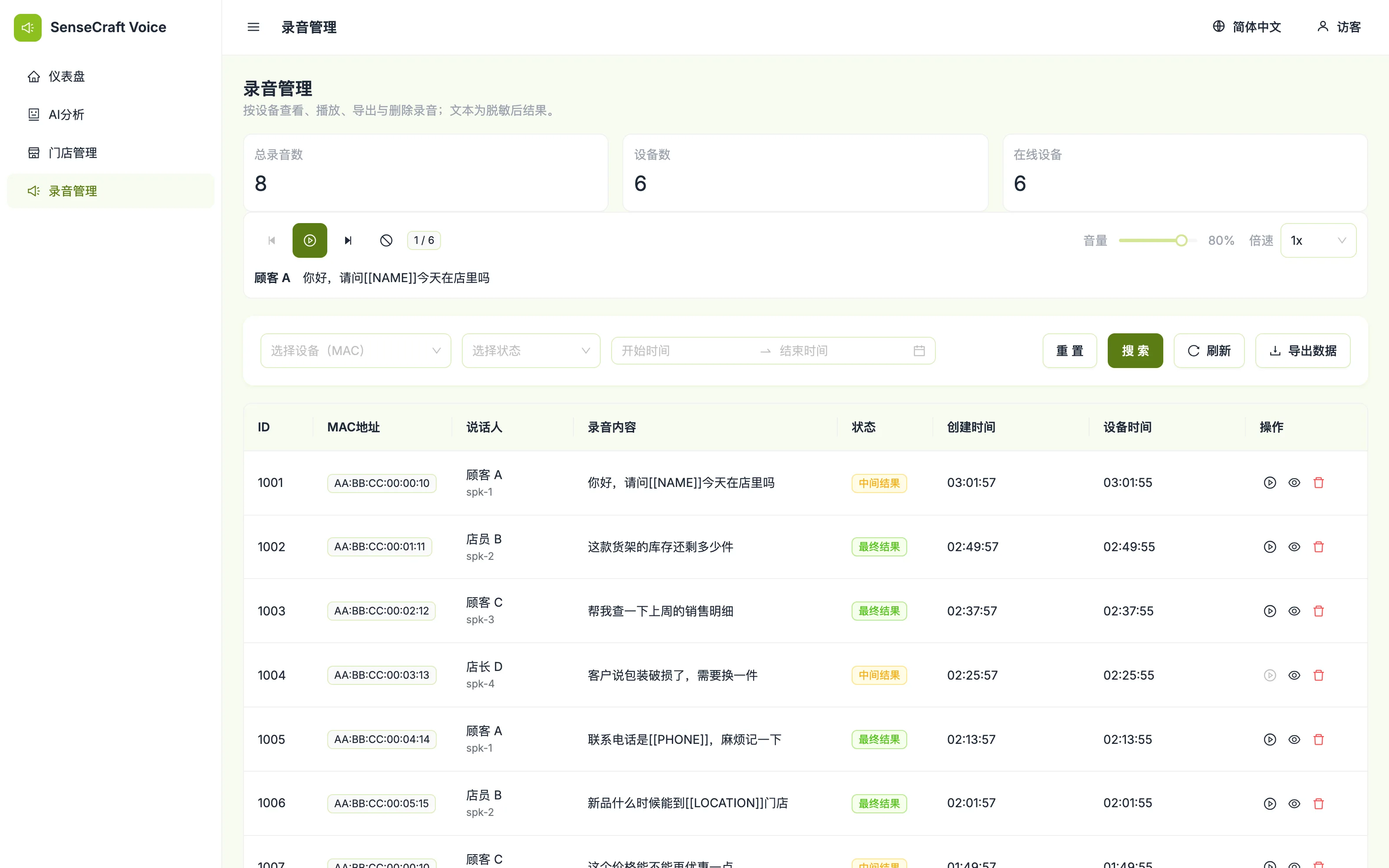
Store, meeting, consultation speech becomes back-office text. Mic array and on-site transcriber, or reSpeaker Clip and phone. Names, numbers masked before storage, deletable on request.
Answer three questions on model size, concurrency and first-token latency, and physical security; the configurator returns specific models. Architecture, host and acceleration, and network isolation are compared in the cards below.
Not sure which to choose? View Complete Selection & Security Deployment Guide →
What should the model do on site? This decides the host platform.
Choose model size, concurrency and security level; the system recommends devices
Sub-1.5B command parsing on the onboard NPU at a few watts
| 硬件/物料名称 | 数量 | 型号/SKU | 说明 |
|---|---|---|---|
| reComputer RK3576-30 (RK3576, 8GB) | 1 | 100052518 | - |
| reSpeaker XVF3800 Microphone Array | 1 | 101991441 | - |
| NVMe M.2 2280 SSD 1TB | 1 | 112990267 | - |
| RTL8822CE Wi-Fi 5 / BT 5.0 Wireless Module | 1 | 114993556 | - |
7B/8B dialogue and knowledge retrieval, with speech transcription and vector search on the same box
| 硬件/物料名称 | 数量 | 型号/SKU | 说明 |
|---|---|---|---|
| reComputer Super J4012 (Orin NX 16GB Super) | 1 | 114110314 | - |
| reSpeaker XVF3800 Microphone Array | 1 | 101991441 | - |
| NVMe M.2 2280 SSD 1TB | 1 | 112990267 | - |
| Power Adapter (19V 4.74A / 90W) | 1 | 313080684 | - |
| RTL8822CE Wi-Fi 5 / BT 5.0 Wireless Module | 1 | 114993556 | - |
7B at 50–61 tok/s for concurrent requests and long-context RAG; the accelerator card is quoted by sales
| 硬件/物料名称 | 数量 | 型号/SKU | 说明 |
|---|---|---|---|
| reComputer RK3588-40 (RK3588, 16GB) | 1 | 100086238 | - |
| RM1828 PCIe Accelerator Card (RK1828, quoted by sales) | 1 | - | - |
| reSpeaker XVF3800 Microphone Array | 1 | 101991441 | - |
| NVMe M.2 2280 SSD 1TB | 1 | 112990267 | - |
| RTL8822CE Wi-Fi 5 / BT 5.0 Wireless Module | 1 | 114993556 | - |
14B–27B multi-step reasoning and multi-agent, 7B/8B with 8 concurrent streams
| 硬件/物料名称 | 数量 | 型号/SKU | 说明 |
|---|---|---|---|
| reComputer J5012 (AGX Orin 64GB) | 1 | 100032662 | - |
| reSpeaker XVF3800 Microphone Array | 1 | 101991441 | - |
| NVMe M.2 2280 SSD 1TB | 1 | 112990267 | - |
| RTL8822CE Wi-Fi 5 / BT 5.0 Wireless Module | 1 | 114993556 | - |
Four layers in the diagram: a microphone array captures speech; a reComputer host, either Jetson or RK; TensorRT-LLM, RKLLM and the optional RM1828 card run quantized inference on the host; results drive field devices over Modbus, CAN and RS485 and reach the business network through separate Ethernet ports.
Core Advantages
| Image | Product | Core Positioning | Recommended Model & Quantization | Decode Speed (tok/s) | Concurrency | Cost |
|---|---|---|---|---|---|---|
 | J5012 | AGX Orin 64G | Qwen2.5-14B, Qwen3.5-27B, INT4-AWQ | 7B 45.5; 14B 24.5; 27B 14.5 | 7B/8B 8 streams about 175–185 tok/s total; 14B 4 streams; 27B 2 streams | ~$2800–4800 |
 | J4012 | Orin NX 16G | Qwen2.5-7B, Llama-3.1-8B, INT4-AWQ; 14B loadable | 7B 22.5; 8B 23.5; 14B 11.0 | 7B/8B 2 streams, 14B 1 stream; spare memory runs Whisper and vector retrieval | ~$900–1800 |
 | J3011 | Orin Nano 8G | Qwen2.5-1.5B, Qwen2.5-3B, INT4-AWQ; 7B single-task only | 1.5B 38.5; 3B 22.5; 7B 12.5 | 1.5B 2 streams, 3B 1–2 streams | ~$600–1000 |
 | RK3588-40 | RK3588 + RM1828 accelerator | With card: Qwen2.5-7B, Qwen3-4B, W4A16; native: Qwen2.5-1.5B, W8A8 | With card 7B decode 50–61, prefill above 800; native 1.5B 16.5, 7B about 4 | One resident model per card; speech recognition and synthesis run on the host | Host ~$280–360; RM1828 card quoted separately |
 | RK3576-30 | RK3576 native | Qwen2.5-0.5B, Qwen2.5-1.5B, W4A16 | 0.5B 35.2; 1.5B 19.6; 4B 8.3 | Single-stream command parsing; a 4B chat model is not recommended alongside speech | ~$160–210 |
Select hardware systematically across Jetson Orin unified memory and Rockchip NPU/RM1828 3D-stacked accelerators by parameter size and concurrency.
Core Advantages
| Image | Accessory | Specifications & Purpose | Compatible Models | Security & Selection Rules |
|---|---|---|---|---|
 | Wi-Fi 5 / BT 5.0 Wireless NIC Kit | M.2 Key-E, dual-band 2.4G/5GHz Wi-Fi & BT 5.0 with dual whip antennas | Universal | Optional for office & field debug; 【Air-gap tier】omit at factory or detach module on-site to fully cut RF transmissions |
 | 1TB NVMe M.2 2280 SSD | PCIe Gen3x4, sequential read/write > 2000 MB/s for high-capacity local storage | Universal | Essential for on-device LLMs; stores 7B/14B quantized model weights (4–8GB) and vector search index (Milvus/Chroma), avoiding SD card bottlenecks |
 | 19V 4.74A (90W) Power Adapter | 5.5×2.5mm DC barrel jack, true 90W delivery with surge protection | Jetson Orin / RK3588 | Essential for full power; guarantees stability during 20W/25W MAXN power spikes in prefill and multi-stream decoding, preventing brownout resets |
 | reComputer Metal Rack Mount Holder | Industrial cold-rolled steel bracket, supports standard 35mm DIN-rail and wall mounting | reComputer Series | Standard accessory for industrial cabinets; shockproof mounting and improved thermal airflow |
| — | Dual Isolated GbE & Industrial Bus | Dual physical Gigabit Ethernet ports + onboard isolated RS485 / CAN / DO terminals | Industrial Series | Air-gapped deployment; LAN1 connects to PLC production bus, LAN2 connects to maintenance network, kernel IP forwarding disabled |
Covers core deployment accessories for on-device LLMs including storage drives, stable power supplies, DIN-rail mounting brackets, and communication modules. For classified or air-gapped environments, users can omit or physically detach the M.2 Key-E wireless NIC to completely sever all RF emissions, paired with dual-GbE physical isolation and onboard industrial fieldbuses.
Core Advantages
In autoregressive LLM decoding, generating every new token requires streaming billions of parameter weights from RAM, making memory bandwidth the hard performance ceiling. Generation speed (tokens/s) scales directly with bus throughput (GB/s). This is why platforms with higher bus bandwidth—such as Orin NX (102.4 GB/s) or the RM1828 accelerator with 1 TB/s 3D-stacked memory—drastically outperform systems constrained by standard onboard LPDDR.
Yes. With INT4-AWQ quantization, Qwen2.5-7B and Llama-3.1-8B consume only 5.2GB to 5.8GB of RAM. The reComputer J4012 offers 16GB unified memory, leaving ~10GB of headroom—more than enough to run the offline Whisper-base speech engine (~1GB) and a local vector store concurrently for fully air-gapped full-duplex conversational voice AI.
Under INT4 quantization, 27B–32B model weights alone demand over 17GB of VRAM. Accounting for dynamic KV caching and OS overhead pushes total memory past 20GB–24GB, exceeding the physical RAM ceiling of 8GB/16GB edge devices and causing out-of-memory crashes or swap thrashing. Deployments requiring 27B+ models should route queries across the private LAN to dedicated on-premise x86 servers.
Wi-Fi and Bluetooth wireless connectivity on the reComputer industrial edge series relies entirely on modular M.2 Key E cards, with zero on-board surface-mount RF chips. In high-security air-gapped facilities, simply removing the chassis screws and detaching the M.2 card physically cuts off all RF transmitters, creating a true hardware air-gap.
Yes. The Seeed edge computing devices in this solution support custom logos, enclosures, packaging, and pre-loaded firmware. We can also adapt existing models to add or remove interfaces, accelerators (such as RM1828), or fieldbuses. , or see Customization Service for scope and process.